Running a small business can feel like carrying the weight of the entire team on your shoulders.
You build the employee schedule. You answer last-minute texts. You train new hires. You remind people about tasks. You cover shifts. You fix mistakes. You answer the same questions over and over again. Then, after doing all of that, you are still expected to focus on customers, sales, operations, inventory, payroll, and actually growing the business.
For restaurant owners, café operators, and small business managers, the schedule is often blamed for the chaos.
But the schedule usually isn’t the real problem.
The real problem is what happens after the schedule is posted.
Employee Scheduling Is Only the Beginning
Employee scheduling software can tell your team when to work, but it cannot solve every challenge that comes with managing people.
An employee can know that they are scheduled from 8 a.m. to 4 p.m. and still walk into work unsure about what needs to be done, what has changed, what they are responsible for, or whether they are meeting expectations.
This happens every day in small businesses.
The schedule lives in one place.
Training materials live somewhere else.
Tasks are written on a whiteboard.
Important updates are sent through text messages.
Policies are buried in an employee handbook.
Performance feedback happens whenever a manager has a few minutes to pull someone aside.
Even when everyone is trying their best, the system itself can make success harder than it needs to be.
And when the system is unclear, managers usually end up carrying the burden.
The Hidden Cost of Managing a Team Through Texts, Notes, and Memory
At first, managing a team informally can feel easy.
You have a small group of employees. Everyone knows each other. Someone needs a shift covered, so you send a text. A procedure changes, so you mention it during the next shift. A new hire starts, so one of your experienced employees shows them what to do.
It works.
Until the business grows.
Then the group chat gets busier.
More employees are hired.
People work different shifts.
Different managers give different instructions.
Training becomes inconsistent.
One employee hears about a new procedure while another never does.
Eventually, the manager becomes the system.
Employees start asking:
“What time do I work tomorrow?”
“Where is the training sheet?”
“Was I supposed to do that?”
“Can you send me the schedule again?”
“Who is covering this shift?”
“What am I supposed to work on today?”
And the manager answers.
Again.
And again.
And again.
This is where small business management becomes exhausting.
Not because the employees are necessarily bad.
Not because the manager is doing a poor job.
But because too much information is being held together through conversations, memory, paper, spreadsheets, and disconnected tools.
Good Employees Still Need Clear Expectations
One of the easiest mistakes to make in employee management is assuming that people automatically know what good performance looks like.
Managers see the business from a completely different perspective than employees do.
A manager may know that showing up five minutes late creates problems for the next shift. They know why a closing checklist matters. They understand why completing training is important. They can see how one missed task affects the entire operation.
An employee may only see their individual shift.
That gap matters.
Employees are much more likely to succeed when expectations are visible, consistent, and easy to understand.
They should know:
When they are working.
What they are responsible for.
What training they need to complete.
What tasks are expected of them.
Where important company information is located.
How they are performing.
And where they are improving.
Clear expectations remove guesswork.
And when employees do not have to guess, managers do not have to constantly correct.
Accountability Should Not Only Happen When Something Goes Wrong
For many employees, the only time they hear about their performance is when they make a mistake.
They are late.
A task is missed.
A customer complains.
A manager notices something was not completed correctly.
Then the conversation happens.
But what about everything they are doing right?
What about the employee who consistently arrives on time?
The person completing training ahead of schedule?
The team member who always finishes their tasks?
The employee who has improved dramatically over the last several months?
Those wins are easy to overlook when managers are busy solving the next problem.
That can be discouraging.
Employee performance tracking should not exist only to identify poor performance. It should also help employees see their progress.
When people can see that they are improving, completing training, becoming more reliable, and contributing to the team, accountability begins to feel different.
It becomes less about being watched.
It becomes more about growth.
That is especially important for younger employees or people entering a new industry. Many of them want to improve, but they need a clear path to understand what improvement actually looks like.
Employee Training Should Continue After the First Week
Another challenge small businesses face is employee training.
New employees are often given a large amount of information during their first few shifts.
They learn company procedures, customer service expectations, equipment, safety rules, recipes, systems, opening procedures, closing procedures, and dozens of other details.
Then they are expected to remember everything.
In reality, good employee training is not a one-time event.
It is an ongoing process.
Employees should be able to revisit training materials when they need them. Managers should be able to see where someone is in the training process. Employees should know what they have completed and what comes next.
This is particularly important in restaurants and cafés, where consistency has a direct impact on the customer experience.
One employee following a different procedure can affect product quality, service speed, cleanliness, safety, and ultimately the reputation of the business.
A strong training system creates consistency.
Consistency creates confidence.
And confident employees require less constant supervision.
Managers Need Visibility, Not More Work
Small business owners already have enough to manage.
The solution cannot simply be another tool that creates more administrative work.
Managers need visibility.
They need to be able to quickly understand what is happening with their team.
Who is scheduled?
Who is consistently arriving on time?
Who still needs to complete training?
Which tasks have been finished?
Who has been improving?
Who may need additional coaching?
When this information exists across multiple systems, managers have to piece together the story themselves.
But when schedules, employee training, time tracking, tasks, communication, and performance information are connected, it becomes much easier to understand what is really happening.
Instead of reacting to problems after they happen, managers can start identifying patterns earlier.
That is a much better way to lead a team.
A Better System Helps Everyone
The goal of better employee management should not be to control people more.
It should be to make expectations clearer.
Employees benefit because they understand what is expected of them.
Managers benefit because they spend less time repeating instructions.
Owners benefit because they gain better visibility into their business.
Customers benefit because the team becomes more consistent.
Everyone wins when the system works.
This is the idea behind AcznTeams.
Why We Built AcznTeams
AcznTeams was built around a simple belief:
Managing employees should not require five different systems just to keep everyone moving in the same direction.
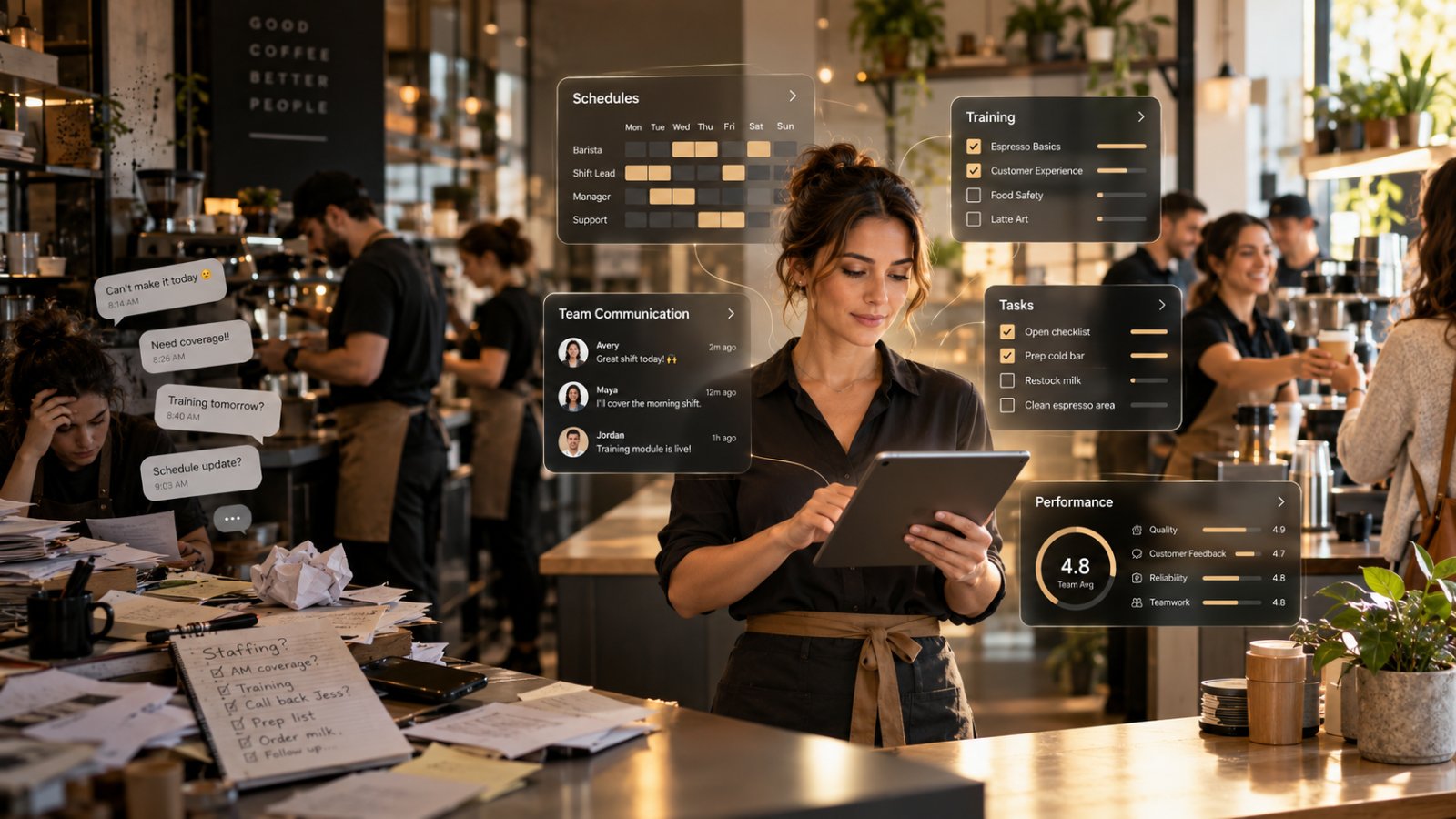
AcznTeams brings employee scheduling, training, tasks, team communication, time tracking, and employee performance progress together in one place.
Instead of looking at scheduling as the entire solution, we believe the schedule should be the starting point.
From there, businesses should be able to help employees learn, understand their responsibilities, complete tasks, communicate with their team, and see their own progress.
Managers should be able to understand how their team is doing without constantly chasing people for information.
And employees should have a clearer path to succeed.
Because most employees want to do a good job.
Most managers want to lead well.
Most business owners want to build a strong team.
Sometimes what is missing is simply a better system connecting everyone together.
Your Schedule May Not Be the Problem
If you find yourself constantly answering the same questions, repeating the same instructions, searching for training documents, reminding employees about tasks, or trying to remember who is actually performing well, it may not be a scheduling problem at all.
It may be a systems problem.
The strongest teams are not built simply by putting names into time slots.
They are built through clear expectations, consistent training, communication, accountability, recognition, and progress.
Your employees should know where they need to be.
But they should also know where they are going.
That is the future of employee management we are building at AcznTeams.